Roster Realignment Before the Postseason
The Tampa Bay Lightning have initiated a series of critical roster maneuvers as they prepare to open their first-round postseason series against the Montreal Canadiens. These adjustments, executed in the final hours before game one, highlight the complex, often friction-filled interplay between the NHL’s primary roster requirements and the development goals of its AHL affiliate, the Syracuse Crunch. Managing a roster during the playoffs requires a level of cold-blooded logistics that fans rarely see, as teams must balance the immediate hunger for a Stanley Cup with the long-term need to maintain a viable pipeline in the minors.
The Return of Dominic James
The headline move for Tampa Bay is the activation of forward Dominic James from injured reserve, as confirmed by Diandra Loux. James, who has been sidelined since February following leg surgery, recently demonstrated momentum by scoring in back-to-back appearances prior to his injury, proving he has the offensive instincts required to contribute in tight spaces. His return provides head coach Jon Cooper with a tactical option at the fourth-line center position, a role James was seen practicing in as recently as Friday, per reporting from Eduardo A. Encina. Inserting a player coming off a major lower-body injury into the frenetic pace of a playoff series is a gamble, yet Cooper clearly values James’s specific defensive reliability over the raw speed of younger, untested alternatives.
Managing Depth and Postseason Attrition
Simultaneously, the organization pulled significant depth assets from Syracuse, recalling forward Conor Geekie and goaltender Brandon Halverson. This consolidation reflects a strategic hedge against the inevitable, grinding attrition that defines a seven-game series. Geekie, the 10th overall pick in the 2022 draft, served as the Crunch’s second-leading scorer this season with 59 points in 57 games, suggesting he has outgrown the developmental stage. His NHL experience—spanning 14 games this year—positions him as the primary candidate to step in should the health of the bottom-six forward group, currently complicated by an upper-body injury to Pontus Holmberg, deteriorate further. Relying on an unproven rookie during a critical series is a standard emergency protocol, but the Lightning are betting that his AHL offensive confidence will translate if he is forced into the lineup.
Goaltending Insurance Policies
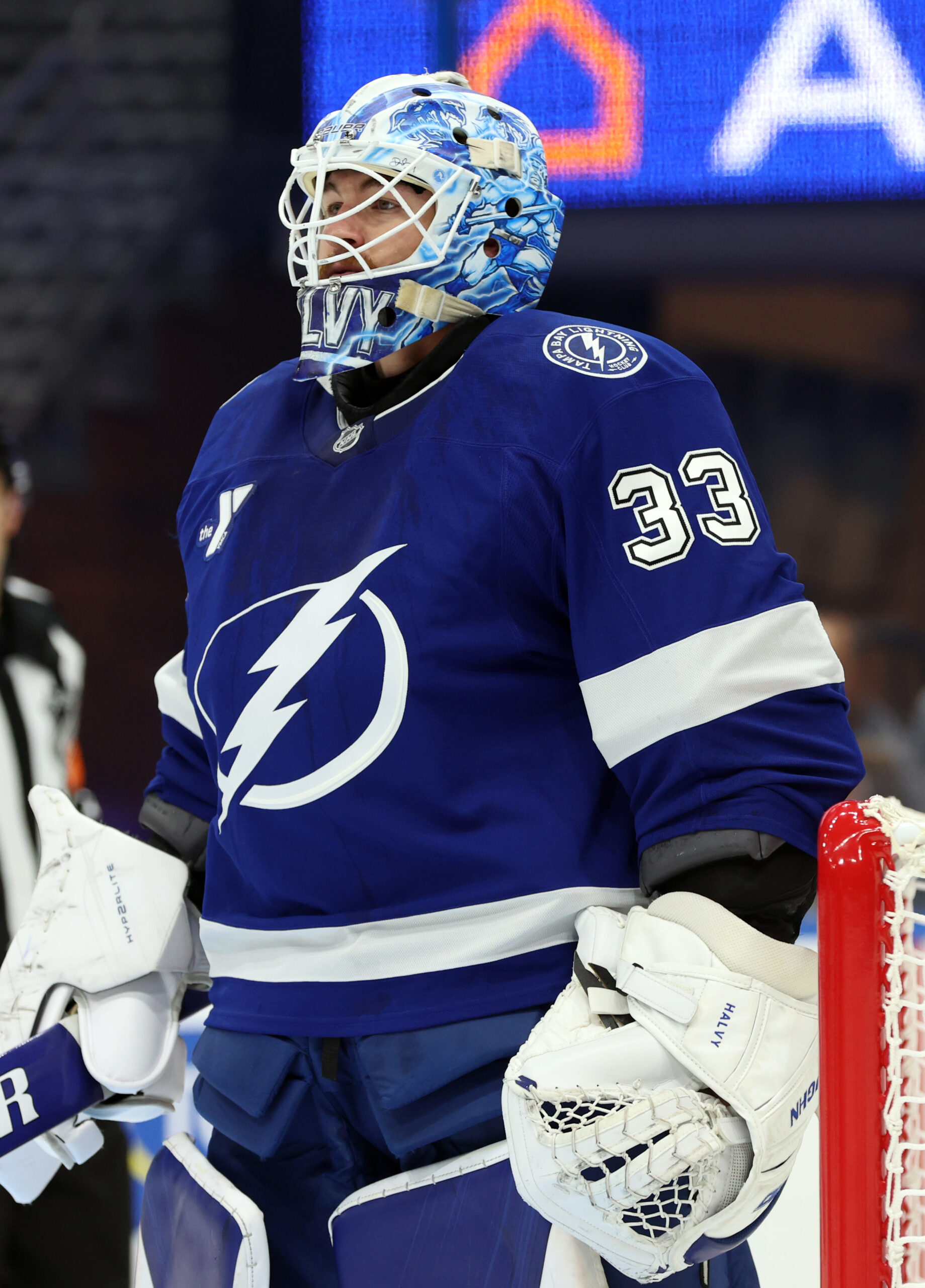
The inclusion of Halverson on the NHL roster suggests a conservative approach to goaltending security behind starter Andrei Vasilevskiy and backup Jonas Johansson. By pulling Halverson, who posted a .905 save percentage in 43 games for the Crunch, the Lightning have effectively shifted the goaltending burden to Ryan Fanti for the AHL playoffs. Fanti, having recorded an identical .905 save percentage in 27 appearances, represents an unproven but statistical peer to Halverson, highlighting the internal depth management required when organizational goals overlap in April. While the goal is to win it all, the Lightning front office is meticulously ensuring they have a netminder who can handle the pressure if either Vasilevskiy or Johansson falter, even if it leaves their minor-league affiliate vulnerable.
Reassignments and Strategic Utility
To accommodate these arrivals, the Lightning reassigned forwards Mitchell Chaffee and Jakob Pelletier, along with defenseman Steven Santini, back to Syracuse. These reassignments are less about organizational preference and more about maximizing the utility of active players during a time-sensitive period. Pelletier, the leading scorer for the Crunch with 77 points, is a vital piece for their immediate playoff push, and his physical profile makes him a lower-priority candidate for the grinding, high-stakes environment of the NHL postseason, where size and experience are often prioritized over raw offensive output. The team is essentially deciding that Pelletier is more valuable to the Crunch’s winning culture than he is as a spare part sitting in an NHL press box.
While Chaffee struggled to produce in the NHL, recording only one point in 11 games, his prior postseason experience remains a latent asset that the front office is unwilling to discard. He acts as the team's insurance policy—a high-probability recall should the Lightning require immediate professional experience in the event of injury. Santini, meanwhile, provides the structural defensive competence necessary for a deep run in the AHL, having logged his most significant NHL ice time since 2019 earlier this season. By shifting these pieces, the Lightning are attempting to maintain a winning environment in both Tampa and Syracuse simultaneously.
Strategic Implications and Future Outlook
The reality is that Tampa’s roster construction right now is a fluid, high-stakes calculation. By activating James and reallocating their depth, the front office is attempting to balance the immediate need to combat Montreal with the logistical necessity of supporting the Syracuse Crunch in their own postseason endeavors. Ultimately, the success of this move will be measured not by the roster configuration itself, but by how well the organization handles the inevitable attrition that defines high-level playoff hockey. Teams that fail to manage these transitions often find themselves out of options by game four or five of a series.
The Lightning have clearly hedged their bets by prioritizing depth over star-studded luxury. If the health of their core depth holds, these recalls serve merely as a safety net that will likely never see the ice. If not, the focus will quickly pivot to whether rookies like Geekie can transcend their AHL production and provide meaningful, secondary contributions on the league's grandest stage. If he fails to perform under the bright lights, the front office will undoubtedly face scrutiny for prioritizing AHL stability over acquiring more proven veteran depth at the deadline.
Photos courtesy of Kim Klement Neitzel-Imagn Images