Bayern Munich’s 4-2 win over Stuttgart this past Sunday wasn’t just another routine victory at the Allianz Arena; it solidified a 35th league title, marking a staggering 13 Bundesliga crowns in the last 14 seasons. For Vincent Kompany, the accomplishment serves as the primary validation of a project that, by historical metrics, is currently tracking as one of the most efficient offensive machines in German football history. After inheriting a squad that appeared disjointed and rudderless during the 2022-23 campaign, Kompany has managed to impose a rigid tactical architecture that prioritizes verticality and sustained pressure over the possession-heavy, often stagnant, approach favored by his immediate predecessors.
The numbers behind this campaign are difficult to ignore and arguably border on the anomalous. Having already breached the 100-goal threshold—a feat only previously achieved by Bayern sides in 1971-72 and 2019-20—the team currently sits at 109 goals with four matches remaining. If they maintain their current scoring trajectory against bottom-half opponents, they are poised to push that total toward 120, a figure that would redefine modern offensive standards in the league. This isn't merely about out-muscling inferior opposition; it represents a systematic dismantling of defensive low-blocks that have plagued Munich teams for years, suggesting a level of tactical maturity that was absent even during the tail end of the Julian Nagelsmann era.
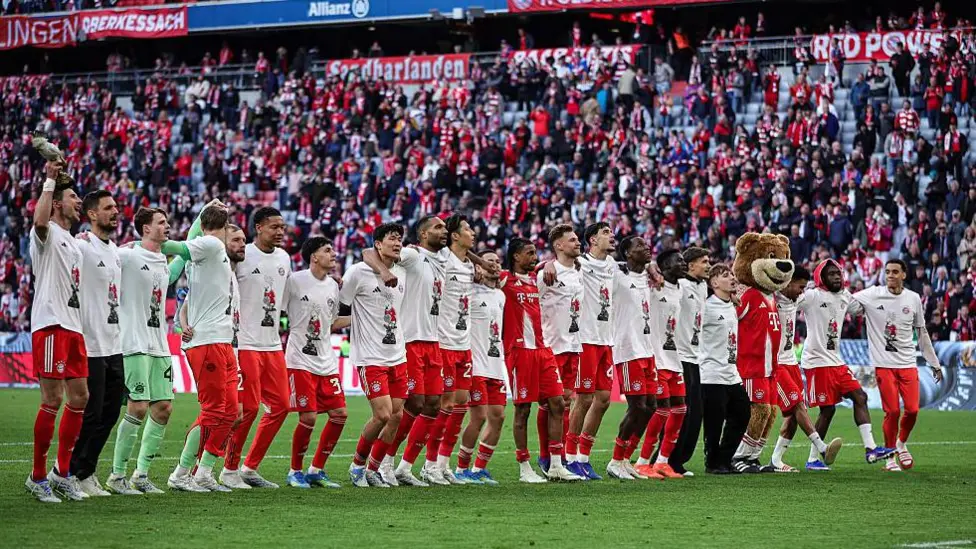
Bayern Munich have won back-to-back Bundesliga titles under Vincent Kompany
The Kane Factor and Systemic Synergy
Central to this output is the efficacy of the forward line, specifically the interplay between Harry Kane, Michael Olise, and Luis Diaz. This trio has accounted for 59 goals, providing the tactical cohesion that was perhaps lacking during the club’s trophyless campaign two years ago. Unlike previous iterations of the Bayern attack, which often relied on individual brilliance from the wings, this system integrates the midfield into the final third. Kane serves as the fulcrum, frequently dropping deep to drag center-backs out of position, which creates the space for Olise and Diaz to exploit the half-spaces. For Kane, individual milestones—50 goals across all competitions this season—have now finally aligned with the team-level success he sought upon his arrival in Germany, silencing the superficial criticism that he was an individualist playing for a collective giant.
Kane’s current standing is a direct response to the scrutiny he faced during his first year, where pundits questioned his fit within the high-intensity Bayern press. With 32 goals in 27 league appearances and a pivotal role in reaching the Champions League semi-finals—including goals in both legs against Real Madrid—the English captain is moving beyond mere domestic production. He has reached 15 goals in the knockout stages of the Champions League, matching Frank Lampard’s record for an Englishman in the competition. However, Kane remains pragmatic about the requirements for individual honors, acknowledging that without a Champions League title or significant international success this summer, the path to a Ballon d'Or remains narrow. His performance this season has essentially transformed him from a pure striker into a sophisticated playmaker-finisher hybrid, a evolution that Kompany has encouraged by granting him greater freedom of movement within the offensive third.

Harry Kane has scored 139 goals in 136 games since joining Bayern in 2023
Strategic Evolution and Defensive Stability
Kompany’s influence should not be understated; he has fundamentally altered the club's defensive philosophy. After a transitional first year, the squad has internalized his tactical framework, which emphasizes a high defensive line supported by rapid counter-pressing mechanisms that stifle opposition transitions before they reach the final third. The defensive record—conceding only 29 goals—complements their offensive output, creating a balanced unit that is closing in on the 91-point record set by Jupp Heynckes’ Treble-winning squad in 2013. This stability, often ignored in favor of the flashy goal statistics, is precisely what differentiates this team from the fragile Bayern outfits of previous seasons.
The European Crucible
The immediate challenge for Bayern is clear: transitioning this domestic dominance into European silverware. They are currently managing a high-stakes schedule, with semi-finals against Bayer Leverkusen in the DFB-Pokal and Paris St-Germain in the Champions League looming, both of which will expose any lingering structural weaknesses. Success in these fixtures would place the current squad in rarified air, potentially becoming the first European men's team to secure the Treble on three separate occasions. Whether they can manage the mental and physical toll of such high-frequency, high-stakes competition remains the single biggest question for the coaching staff as they navigate the remainder of the calendar.
The upcoming month will serve as the ultimate stress test for Kompany’s system. While the Bundesliga title is secured, the true evaluation of this team’s historical standing hinges on whether they can maintain this velocity through the final, high-pressure hurdles of the European calendar. It is one thing to dominate a domestic league that is structurally favoring your financial muscle, but managing the tactical nuances required to bypass a PSG side or a disciplined Leverkusen setup is a different tier of coaching expectation. If Kompany falters here, the narrative around his "revolutionary" project may quickly pivot to one of missed potential.
For more on this topic, consider the latest updates regarding Bayern Munich's squad rotation as they look to preserve fitness for the impending cup ties. The club’s ability to sustain its current intensity will remain the central narrative until the final whistle of their season, as they attempt to balance the rotation of key players against the need for consistency in rhythm. The depth of the bench, which has rarely been tested due to the team’s relatively injury-free run, will likely become the determining factor in these closing weeks.
Takeaway: Bayern’s record-breaking offense is a byproduct of long-term tactical absorption under Kompany. Whether this translates to a third historical Treble will be decided by their ability to maintain defensive discipline under the heightened scrutiny of the Champions League knockout phase, where errors are punished with a severity rarely seen in the Bundesliga.